Block Away - Tap Out Puzzle
- 4.7
- Rating
- 10.00M
- Installs
- Free
- Price
 Analysis by App-foxy
I went into Block Away - Tap Out Puzzle expecting a simple block-clearing distraction, and that is exactly where it works best: as a focused puzzle game for short sessions. The basic idea is easy to understand, but the need to fit and rotate pieces before they interfere with one another gives each board a little more tension than a standard matching game. I found myself playing it while waiting for an appointment, then returning later because I wanted to solve one more awkward layout.
This is a free puzzle game from Tripledot Studios Limited, rated for Everyone. It has reached over five million installs and holds a 4.6 average from roughly two hundred fourteen thousand ratings, which suggests that the straightforward format has found a sizeable audience. My experience was positive overall, though I would not call it a perfect fit for every type of puzzle player. Its appeal depends heavily on whether you enjoy spatial planning more than story, competition, or constant novelty.
How the board turns a simple idea into a thoughtful challenge
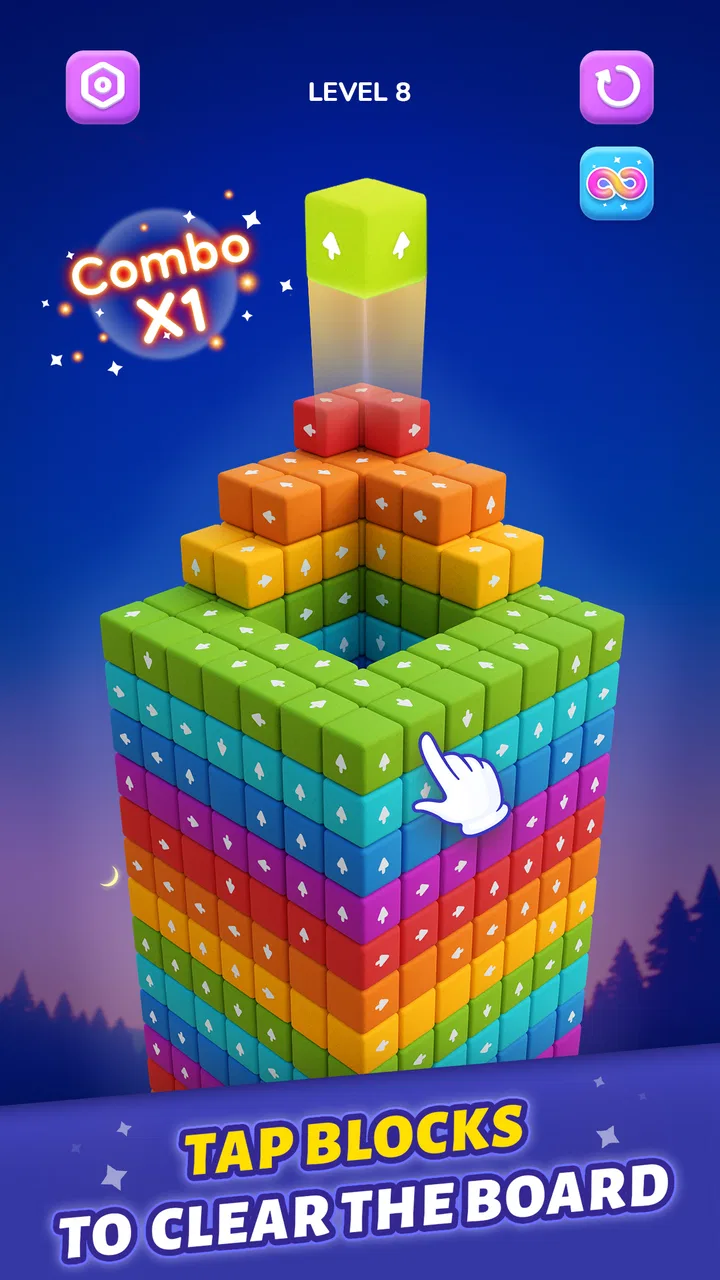
The objective is to clear the board by placing blocks so that complete rows and columns disappear. Rotating pieces is central rather than optional decoration: a shape that looks useless in one direction can become the key to opening space when turned. I like this because it makes each move feel deliberate. You are not merely searching for a matching color or tapping the most obvious item; you are judging empty areas, future placements, and the risk of sealing off a useful lane.
You May Also Like

 Blood Strike: 2.5 Anniversary
Blood Strike’s Loadouts Turn Every Drop Into a Tactical Gamble
A close look at Blood Strike’s custom loadouts: how fast access to signature weapons reshapes its battle royale rhythm, rewards preparation, and narrows the gap between fights.

 Pandora - Music & Podcasts
Pandora’s Music Is Easy to Start, but Harder to Recover
Pandora’s strength is its low-effort path from a seed to a station. Its weak spot is how much confidence it asks you to place in connection, setup, and quiet recovery.

 8 Ball Pool
 Is Built on Rivalries, Rematches, and Routine
A close look at the rivalries, rematches, shared routines, and unanswered safety questions that turn a quick pool match into a persistent mobile community.

 Samsung Music
’s Quiet Strength Is Playing What You Already Own
Its reach comes less from spectacle than from dependable access to a personal library. That simplicity is both the app’s strongest retention engine and its ceiling.

 AccuWeather: Weather Radar
AccuWeather Review: A Quick, Clear Forecast for Everyday Decisions
For everyday plans, the best forecast is the one you can understand quickly. AccuWeather makes rain timing, radar, and local conditions easy to act on, with a few trade-offs.

 Hill Climb Racing
Why Hill Climb Racing Still Turns Crashes Into One More Run
A tiny car, a bumpy hill and one more upgrade: Hill Climb Racing keeps resurfacing because its simple chaos makes every near-miss feel personal.
More From Our News Desk



The controls are approachable enough for someone who rarely plays puzzle games. There is no long tutorial concept to learn before the main idea makes sense. At the same time, the simplicity can be deceptive. Early moves often seem harmless, but a poorly placed block can create a narrow pocket that accepts very little later. I learned to inspect the whole board before committing, especially when a piece could fit in several locations.
One useful habit is to treat open space as a resource rather than as leftover room. I try to preserve at least one flexible area for unusual shapes, instead of filling every gap immediately. This is a small change in thinking, but it makes the game feel less random. When the board becomes crowded, I also look for the placement that clears a row or column soonest, even if it is not the most visually tidy option.
That approach reveals one of the game’s strongest qualities: it rewards planning without requiring complicated rules. A player can start casually, then gradually notice patterns in how space disappears. The best moments come when a rotation solves two problems at once, opening a line while leaving a good position for the next block. Those moments feel earned because the board’s geometry, rather than a flashy effect, creates the payoff.
Why the short-session format works
I can see this game fitting naturally into everyday gaps. Imagine sitting on a train with a few minutes before your stop. A board gives you something focused to do, but it does not demand a long narrative commitment or a large amount of preparation. If you need to put the phone away, the puzzle is easy to leave and return to without remembering a complicated plot or a chain of objectives.
It also works as a wind-down activity because the rules are calm while the decisions remain active. I would not describe every board as relaxing, particularly once the available space becomes tight, but the mental effort is controlled. For me, it sits between a completely passive time-killer and a demanding logic puzzle that requires uninterrupted concentration.
The trade-off is that the same focused design can become repetitive. There is no story carrying me from one situation to another, and the core action remains placing and rotating blocks. Players who need changing environments, characters, or puzzle types may find the loop narrow after extended sessions. I enjoyed it more when I played in bursts than when I tried to treat it as a long evening game.
Progress feels more personal than competitive
The pressure in this kind of puzzle comes from the board itself. Every placement changes the space available for later pieces, so a mistake can create a problem several moves afterward. I appreciate that the challenge is easy to understand: when a board goes wrong, I can usually identify the cramped corner or premature placement that caused it. That makes failure feel instructive rather than mysterious.
My main advice is not to chase an immediate clear at the expense of flexibility. Completing a row or column is satisfying, but sometimes the better move is to place a block in a less obvious position that keeps multiple routes open. I also avoid filling a large central area too quickly. Keeping room around the middle gives rotated pieces more chances to connect with existing lines.
Another practical technique is to consider the largest awkward shape first. Small blocks can often fit in several places, while a long or irregular piece may have only one sensible home. If I place the easy pieces before solving that constraint, I can accidentally remove the only space it needed. This is the sort of detail that does not appear in a short store summary but makes a real difference once the basic rules are familiar.
The game is best for people who enjoy improving their own decisions. If you want a strong narrative reward, a character collection, or a clearly defined campaign, this is probably not the right choice. It is also less suitable when you want a puzzle that can be solved by following a fixed sequence. The board asks you to adapt, and the satisfaction comes from finding a workable arrangement rather than discovering one predetermined answer.
What spending means here
The game is free to download, with in-app purchases ranging from $1.99 to $99.99 per item. That is the important spending context I would keep in mind before installing it. The purchase range is broad, so I would approach optional spending carefully and decide in advance whether I am comfortable using the game without buying anything.
I do not want to claim that purchases are necessary, nor would I assume that they are irrelevant to the experience. The sensible way to judge the game is to begin with the free version and observe whether the basic puzzle loop already gives you enough value. If you enjoy the board design without feeling pushed to spend, the free entry point is useful. If progress starts feeling uncomfortable unless money is involved, that is a clear sign to stop rather than buy automatically.
For families, the Everyone rating makes the game broadly approachable, but the spending range still deserves adult attention on a shared device. I would use the platform’s purchase controls and talk with younger players before allowing any transactions. That is not a criticism of the puzzle mechanics; it is simply good practice whenever a free game offers paid items.
From a fairness perspective, I judge the experience mainly by whether careful play remains worthwhile. The core design gives the player meaningful choices, so I prefer to improve my board-reading skills instead of treating purchases as the solution to every difficult position. A puzzle game feels most satisfying when a better decision solves the problem. Spending should be a deliberate personal choice, not an automatic response to pressure.
Does it feel fair to a careful player?
In my sessions, the strongest sense of fairness came from the clarity of the objective. I understood what I was trying to do and why a placement helped or hurt. The game does not need complicated explanations to make its challenge readable. When I lost control of a board, it was usually because I had spent space poorly, not because I had forgotten a hidden rule.
That does not mean every difficult moment feels equally comfortable. Spatial puzzles can create a fine line between a challenging position and one that feels nearly closed. The difference depends on how much room remains and how adaptable the next pieces are. I found that patience helped more than frantic tapping. Taking a moment to rotate a block mentally before placing it reduced the number of self-inflicted dead ends.
I would compare it with traditional block-placement puzzles rather than with match-three games. Match-three titles often encourage quick reactions and chain-building, while this game asks me to protect future space. Compared with a classic falling-block game, it feels less about speed and more about arranging a static board. That makes it a better alternative for players who want thoughtful decisions without a timer-like rush, but a weaker choice for anyone who thrives on fast reflexes.
It also differs from sudoku and other number-based logic games. Sudoku rewards deduction from fixed relationships, whereas this puzzle is more visual and spatial. I can play it without calculating numbers, but I still need to anticipate consequences. Players who find sudoku too abstract may appreciate the physical shape of the blocks; players who prefer exact logical certainty may find the open-ended placement less precise.
For a fairer personal challenge, I recommend setting your own stopping point instead of playing until every board becomes exhausting. Once I notice that I am placing pieces automatically, the quality of my decisions drops. A short break often makes the next session more enjoyable and helps separate genuine difficulty from simple fatigue.
What I would want to know before installing
The current version is 2.3.0, and the listed minimum operating-system requirement is Android 7.0 or later. That makes compatibility worth checking before download, particularly if you use an older phone or tablet. I would also confirm that there is enough comfortable screen space for dragging and rotating blocks; a puzzle built around precise placement is more pleasant when the board is easy to see.
The game was released on September 4, 2024, so it is a relatively recent entry in a familiar puzzle style. That matters less than the quality of the central loop, but it helps explain why the presentation and controls feel aimed at current mobile habits. I would not choose it because of the release date alone. I would choose it because the board-based format suits the way I want to spend a few spare minutes.
Another question is whether it is suitable for children. The age classification is Everyone, and the rules are simple enough to explain without requiring advanced reading or gaming experience. Still, younger players may need help understanding why a move that clears one line can make the rest of the board worse. It can be a nice exercise in planning, but I would treat it as a game to discuss and enjoy, not as an educational tool with guaranteed learning outcomes.
People also often want to know whether they can play casually or whether the game demands a serious routine. I found that casual play is its natural strength. You can focus on one board, experiment with rotations, and stop when you have had enough. The deeper strategy is there for players who want it, but the game does not require a formal study plan. That accessibility is one of its better qualities.
On the other hand, users searching for rich social competition should look elsewhere. I would not install this specifically to connect with friends, compare elaborate profiles, or follow a story-driven progression. Its value is concentrated in the individual act of solving space efficiently. That narrow focus is honest and enjoyable, but it also defines the game’s limits.
My verdict after spending time with it
I recommend Block Away - Tap Out Puzzle to anyone who likes visual puzzles, careful placement, and short sessions that can become surprisingly absorbing. The free price makes it easy to try, the Everyone rating keeps the concept broadly accessible, and Tripledot Studios Limited has built the experience around a rule set that is quick to learn but not instantly mastered.
My recommendation comes with two conditions. First, approach it as a self-contained puzzle loop rather than as a story game or a competitive platform. Second, keep the purchase range in mind, from $1.99 up to $99.99 per item, and decide your spending boundary before the game has a chance to influence that decision. I would start free and only consider a purchase if it clearly adds value for my own use.
The most convincing reason to try it is the way rotation changes ordinary block placement into a small exercise in foresight. Saving an awkward space, choosing a line-clearing move, and resisting the urge to fill every gap immediately are simple habits, but they create a satisfying sense of improvement. The biggest weakness is equally clear: the central loop may feel too familiar or repetitive for players who need constant variety.
For me, this is a good companion for waiting rooms, commutes, and quiet breaks when I want something more engaging than scrolling but less demanding than a long-form game. I would skip it if I wanted a campaign, fast action, or a social experience. Otherwise, it earns a place among the more approachable mobile puzzle games, especially for players who enjoy making one careful move at a time. The best part is that better space management, not faster tapping, is what makes the boards feel manageable.
FAQs for Block Away - Tap Out Puzzle
01What is the main objective of Block Away - Tap Out Puzzle?
Block Away - Tap Out Puzzle is a challenging and engaging puzzle game where the primary goal is to clear the board by tapping and removing blocks strategically. Players must think ahead and plan their moves carefully to solve increasingly complex levels. The game offers a stimulating experience that tests both logic and strategic planning skills.
02Is Block Away - Tap Out Puzzle suitable for all age groups?
Yes, Block Away - Tap Out Puzzle is designed to be enjoyed by players of all ages. The intuitive gameplay mechanics make it accessible for younger players, while the increasing difficulty levels provide a satisfying challenge for adults. It’s a great game for families to enjoy together, promoting problem-solving skills in a fun environment.
03Does Block Away - Tap Out Puzzle have in-app purchases?
Block Away - Tap Out Puzzle offers in-app purchases that allow players to acquire additional hints and remove ads. While the game is free to download and play, these optional purchases provide a more enhanced experience by helping players overcome challenging levels and enjoy an ad-free environment.
04How does Block Away - Tap Out Puzzle handle data privacy?
Block Away - Tap Out Puzzle prioritizes user privacy and adheres to standard data protection practices. The app requires minimal permissions and does not collect unnecessary personal information. Users can review the privacy policy within the app or on the developer’s website for detailed information on how data is handled and protected.
05Is an internet connection required to play Block Away - Tap Out Puzzle?
Block Away - Tap Out Puzzle can be played offline, making it a perfect option for on-the-go entertainment without the need for an internet connection. However, some features, like accessing leaderboards and certain in-app purchases, may require an internet connection to function properly.
Pros
- Engaging puzzles that challenge your logic skills.
- Smooth and intuitive touch controls enhance gameplay.
- Visually appealing graphics with vibrant colors.
- Regular updates introduce new levels and features.
- No intrusive ads disrupt the gaming experience.
Cons
- Limited hints can make some levels frustrating.
- Requires internet for cloud save functionality.
- Battery consumption is higher on older devices.
- In-app purchases can be a bit pricey.
- Occasional bugs cause minor gameplay issues.

Block Away - Tap Out Puzzle
Gallery